This is the first issue of the new year and a significant year it is! We are at the beginning of the third millennium since the birth of our Saviour who came, "That we should be saved from our enemies, and from the hand of all that hate us." (Luke 1:71)
He gave us a very simple set of instructions which was to be a composite of government, society, personal needs and spiritual needs. All of this has been, for all practical purposes, forgotten. Professing Christians are being forced, by mandate, to live in a society far removed from "The Way" of Jesus. In all probability most Christians today don't even know about "The Way" and what it entails.
It seems that every passing day brings us the news of something else which has happened to bring us closer to a totally controlled society. Those Christians who understand the meaning of this, and even care about it, are classified as "Christian extremists" or other similar epithets. In reality, what all "old fashioned" Christians want is to return to "The Way" of Jesus. But what is that and is it even possible in today's society?
That passage in Luke is one of the most misunderstood, and otherwise disputed, passages in the New Testament. The enemies of Jesus (and there are many) are becoming extremely disturbed because they now know that Christians everywhere are rediscovering the facts. We here at Christian Crusade for Truth have written about these truths many times. But it is now imperative that those who are just now learning will have concise points of history which can be used as guides in teaching others.
With the plethora of different denominations within our basic faith, it should be obvious that there are a multitude of different opinions not only as to what Jesus came for but to whom as well. Then, to further compound the problem, because of a badly misunderstood Paul, many people of our faith seem not to comprehend just what Jesus taught.
We have intentionally been taught, particularily throughout the more recent years, to believe in a total separation of Church and State. All of these points have been discussed in past issues of the Intelligence Newsletter. But we have sadly neglected just what "The Way" really is. We intend to correct that, too, in this issue.
If we are ever to understand the Kingdom of God as Jesus intended it, we must be convinced that "Church and State" are intertwined and are inseparable. Whenever we discuss "The Way" we are talking about government, law, politics, society, work ethic, and family.
Those who are of the Judeo-Christian persuasion teach that Christianity sprang from Judaism. That is not true and we must show why it is not true. These same people teach that Jesus was a Jew. That also is not true.
Jesus Christ came to save Israel from the Talmudic Pharisees. Returning to the first chapter of Luke, Zackarias, the father of the baby, John the Baptist, was prophesying about the coming Messiah. "Blessed be the Lord God of Israel; for he hath visited and redeemed his people, and hath raised up an horn of salvation for us in the house of his servant David;
"As he spake by the mouth of his holy prophets, which have been since the world began: that we should be saved from our enemies, and from the hand of all that hate us; to perform the mercy promised to our fathers, and to remember his holy covenant; The oath which he sware to our father Abraham." (Luke 1: 68-73)
The oath of God of which Zackarias spoke is found in Genesis 22:16-18: "And said, by myself have I sworn, saith the Lord, for because thou hast done this thing, and hast not withheld thy son, thine only son: That in blessing I will bless thee, and in multiplying I will multiply thy seed as the stars of the heaven, and as the sand which is upon the sea shore; and thy seed shall possess the gate of his enemies: And in thy seed shall all the nations of the earth be blessed; because thou hast obeyed my voice."
Two passages, the one in Luke and the other in chapter 22 of Genesis, have created a conflict of the ages, so to speak. That conflict is not only between two of the world's great religions, but a conflict within each of them separately. It sounds incredible, doesn't it? It's true and all Christians need to understand that conflict.
It is time for all of us to cease blindly obeying the preacher's instructions when he says, "For those things hard to understand, just take in faith as being our points of dogma." Main line churches do not discuss that conflict. We need to understand it if we are ever again allowed to obey Jesus and follow "The Way."
The enemies that Zackarias discussed in Luke 1 were the Talmudic Pharisees. Jesus spent his entire ministry countering the effects of Talmudism. The entire 23rd chapter of Matthew is dedicated to the problems of the Talmud. It wasn't just the Roman Government that hated Christ and His teachings. It was the Talmudic Pharisees who controlled the government of Judea as well as the government of Rome itself.
It was because of the strong opposition to Talmudism, including overturning the money changers' tables in the temple, which brought about the death of Jesus. There will be more on this later as it applies to our modern society.
Jesus said very clearly in His Sermon on the Mount that he did not come to remove the laws, statutes and judgments. In Matthew 5:17-18, "Think not that I am come to destroy the law, or the prophets: I am not come to destroy, but to fulfil. For verily I say unto you, till heaven and earth pass, one jot or one tittle shall in no wise pass from the law, till all be fulfilled." He came to return them into our hearts just like they were at the time of Noah and Abraham.
How can we say that? Well, didn't Noah know the food laws when he separated the clean animals from the unclean animals as he put them on the ark? The laws of clean and unclean animals are found in Leviticus 11. When Abraham's nephew, Lot and his family, were kidnapped by the Kings of Sodom and Gamorrah, he went after them with his trained servants. Today, that would be called a militia, vigalantes, or a posse. Abraham captured the kings and executed them because kidnapping is a death sentence. In Deuteronomy 24:7 is the law: "If a man be found stealing any of his brethren of the children of Israel, and maketh merchanduise of him, or selleth him; then that thief shall die; and thou shalt put evil away from among you."
When Abraham returned with Lot and his family, who met him? It was "Melchizedek king of Salem brought forth bread and wine: and he was the priest of the most high God. And he blessed him, and said, Blessed be Abram of the most high God, possessor of heaven and earth." (Gen. 14:18-19) In the book of Hebrews, chapters 5, 6 and 7, we can read about Jesus being made the high priest for ever after the order of Melchisedec!
Were the Laws, Statutes and Judgments of God done away with in Christ? No, not for one minute. They were placed in our hearts, each and every one of them. As we continue with this issue we will see those times in our history when we acted in this manner and were blessed accordingly.
This issue of whose law shall we follow has been the conflict of the ages. For us to understand the genesis of this we must show how Christianity, or "The Way," which Jesus gave us, has been modified into what is now called Judeo-Christianity. It is a blend of "The Way" and Talmudism. That term is really very descriptive for modern Christianity and we will see how it happened. However, it would be more accurate to call it "Talmudic-Christianity."
All modern doctrines and dogma have developed from the minds of men. The system works in this manner. A minister or theologian will consider a theological point. He then gives a series of sermons to the congregations of many churches. The people go wild over it, mainly because it is delivered in emotional terms and as II Timothy 4:3-4 states, "For the time will come when they will not endure sound doctrine; but after their own lusts shall they heap to themselves teachers, having itching ears; And they shall turn away their ears from the truth, and shall be turned unto fables."
The governmental level of that denomination will then consider those doctrines which greatly excited the congregations. They all agree it should be accepted into the teachings of the denomination. It now becomes dogma and if anyone disagrees and speaks out, he is excommunicated or some other punishment. We then have a theology of fear in that denomination.
In our library is the book Churches and Sects written by Rev. P. Douglas Gorrie in 1850. In that book he describes the origins of each denomination and the debates, arguments, etc., which caused the split from their parent church. Not only do we have new denominations but even the old-time churches were greatly modified with this system.
Some of these doctrines come about innocently but some of them have come about with the specific purpose of destroying "The Way" which Jesus taught. The perfect example of a dogma being developed intentionally to destroy what Christ taught is the doctrine of premillennialism.
This was even observed at the time of the Apostles. Paul, in his letter to the church at Corinth and the epistles to Timothy and Titus, discussed the conflict that had already started to modify Christ's teachings. Later, Martin Luther understood the conflict and he wrote books on the subject. Today, many if not most of the churches using his name will not use his books on the subject!
Most all books on theology and church history written before the turn of the 20th century discussed the phenomenon. Dr. George Fisher of Yale University in 1898 (then one of the best schools of theology in the country) wrote this passage in his book History of Christian Doctrine: "The question for the student to determine is, how far have the ancient creed, their authors and expounders, gone beyond an intellectual equivalent of the New Testament teaching?"
This conflict is no longer discussed by modern theologians. We have the Ecumenical Council attempting to return all denominations to basically the Church of Rome. We have Talmudic (Jewish) Rabbis teaching the Old Testament to students attending modern Christian seminaries. The history of Christianity, back to the second century reveals that students of theology used Talmudic Rabbis to teach the Old Testament. Just what slant do you think they would use to explain the prophets and the laws? Of course it would be with a Talmudic concept. We will explain "the what?" and "the who?" shortly. But first we must show the mechanism which made it even possible to change "The Way," which Jesus taught, into modern Judeo-Christianity. It is a simple phenomena which exists in all of nature.
George Wilhelm Hegel (1770-1831) was a German philosopher and theologian. He has been discredited, and rightfully so, by many because of his teachings of the supreme authority of the state over man. It is also true that Hegel's teachings were adopted by Karl Marx in the development of Communism. However, Hegel simply observed that changes in man's existence came about because of natural conflicts between the various thoughts and concepts which develop in a society. A concept would develop naturally and become a part of society. Hegel called that the thesis. Another concept would develop which was different, or opposed, to the thesis. Hegel called that the antithesis. The conflict between the two concepts would continue for some indefinite time and would eventually accomodate the thesis and the antithesis into what Hegel called the synthesis. The systhesis would then in turn become the new thesis.
All that Karl Marx did was to realize that if a group, such as his Communists, could control the development of the thesis and then also control the development of the antithesis, certainly the synthesis would be exactly what the controlling group wanted in the first place. Hegel called this Dialectical Materialism. Simply stated, that is the way Christianity ("The Way") was changed into Judeo-Christianity. The term "Judeo-Christianity" in itself is an oxymoron.
Ferdinand Christian Baur (1792-1860) was a theologian and philosopher at the University of Tubingen, Germany. He understood Hegel's dialectic concept and observed that this conflict was in fact in Christianity and started at the time of Paul. Modern theologians discredit Baur because of another "dirty word" called conspiracy! The modern world thinks everything just happens with no planning or thought whatsoever!
To give an example to prove differently, we will quote from the book Great Ages and Ideas of the Jewish People, Random House, New York. From the chapter written by Gerson D. Cohen, we read this, "One other source for the self-conscious assertion of the election must be mentioned, for here strangely enough the Jews were the cause of their own embarrassment. The effectiveness of Jewish missionary activity, it is well known, immeasurably facilitated Christian preaching of the Gospel to the gentiles. What is often glossed over is the claim of the Christian preachers to represent the true Israel, their contention that the new sect was the rightful heir to God's revelation to the Patriarchs, Moses and the Prophets.
"The Talmudic community, beginning with the second century, often found itself forced to defend its claim to the title of Israel. One of the deep sources of tension between Judaism and Christianity, one that never appeared in Jewish-Muslim relations, was the debate of two pretenders to the same title. For reasons of prudence, the Christian Church later chose not to emphasize the question of the Israelite name; but the claim to succession is one which the Church never has given up. The Jew, in turn, all the more aggressively affirmed his lineage and his election against all pretenders. Jacob was again at war with Esau over the primal birthright."
One should notice that Cohen uses the phrase "Talmudic community" one time and the term "The Jew" in another. He was referring to the same people when he said that. Let's see if there is a Biblical example of that.
In the Book of Acts, chapter 22:3, Paul was defending himself against the Pharisees who were seeking to kill him. He said to them, "I am verily a man which am a Jew, born in Tarsus, a city in Cilicia, yet brought up in this city at the feet of Gamaliel, and taught according to the perfect manner of the law of the fathers, and was zealous toward God, as ye all are this day."
Paul was speaking here about the laws of the Talmud, not the Laws of God, as codified by Moses. Paul said he was taught by Gamaliel so whatever this man taught is what Paul learned. Again, in the Book of Acts, chapter 5:34 we read this, "Then stood there up one in the council, a Pharisee, named Gamaliel, a doctor of the law..." In Matthew 23, Jesus repeatedly condemns the Pharisees for their actions with such statements, "But woe unto you Scribes and Pharisees." He then stated to them in verse 38, "behold, your house is left unto you desolate." Also, Jesus was speaking about the Pharisees in Matthew 15:9, "But in vain they do worship me, teaching for doctrines the commandments of men." Those "commandments of men" is the Talmud.
By historical definition, Phariseeism is Talmudism and a Jew is one who believes in the Talmud. It has nothing to do with race. There are many people of many different races who believe in the Talmud and consider themselves Jews.
We can now learn what Judeo-Christianity means. Read what Rabbi Ben Zion Bokser wrote in his book The Wisdom of the Talmud. "The growth of Talmudic law, in all its aspects, was for the most part the work of judicial interpretation rather than of formal legislation. The Rabbis who were called upon to administer the old law (he is referring here to the laws of God as codified by Moses) reckoned with the conditions under which it was to be applied. And if they thought the mechanical application of precedent in conflict with the demands of equity, they resorted to reinterpretations which withdrew the new case from the old category into which it seemed, by the rules of formal logic, to fall. The case so decided then became precedent for parallel situations. The judge served in effect as a creator of law and not only as its interpreter, a phenomenon which has been duplicated in every system of jurisprudence."
Rabbi Bokser showed us that modern case law is Talmudic law and has nothing whatsoever to do with the Laws of God. This concept is the source of making the laws of this once Christian land into that of Talmudism.
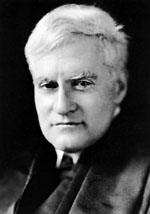
Here are some judicial decisions which made it happen. Supreme Court Justice Oliver Wendell Holmes, Jr. (1841-1932) was appointed to the court in 1902. He wrote that the original Constitution and precedence was of no value in making law. "The justification of a law for us cannot be found in the fact that our fathers always have followed it. It must be found in some help which the law brings toward reaching a social end." Rabbi Boxzer said the same thing, using other words.
|
|
Benjamin Cardozo (1870-1941) was appointed to the Supreme Court in 1932. This is what he wrote, "If there is any law which is back of the sovereignty of the state, and superior thereto, it is not law in such a sense as to concern the judge or lawyer, however much it concerns the statesman or the moralist." Judge Cardozo simply said that the moral Laws of God were not to concern the judge! That's how Bokser defined the Talmud.
Charles Evans Hughes (1862-1948) was Supreme Court Chief-Justice from 1930 to 1941. This is what he wrote, "We are under a Constitution, but the Constitution is what the judges say it is." According to Rabbi Bokser, that's what the Talmud says, isn't it?
Even Earl Warren, Chief-Justice starting in 1953 made somewhat the same statement as Bokser's. Warren said this, "The Constitutional Amendment must draw its meaning from the evolving standards of decency that mark the progress of a maturing society."
We have shown sufficient evidence that the United States is now a Talmudic nation. Judeo-Christianity is an American phenomenon. When we study the history of the modern church in America, we find that the term Christianity was changed to Judeo-Christianity in the same time frame as those judges made their declarations.
The Christians of the United States had been able to withstand this assault through its early years. Honest historians state that the United States had its "Golden years" from 1800 to 1830 and then it started its long down-hill slide into what we see today. That was no accident. Our people had a type of Christianity during those years which could be closely related to "The Way" of Jesus. We will explain this shortly.
Returning to the early years of Christianity, Sir James Frazer stated in his book The Golden Bough, "By the year 200 A.D., Christianity, as taught by Jesus Christ had all but disappeared. The question we must ask ourselves is, how did this happen?"
The beginning of the conflict started shortly after the Resurrection of Jesus. There were two schools of thought being developed. One was the school at Alexandria in Egypt and the other was at Antioch in Greece.
We must remember that none of these people at either school had the New Testament. The New Testament was not to become canon for nearly 200 years. They had the Old Testament in the Septuagint version. They studied the teachings of the Apostles. They all knew that the Apostles had enemies. Otherwise, why would they all have been martyred?
The school at Alexandria was made up primarily of men who were converted Talmudists. In general those at the Alexandrian school simply tried to reform "The Way" which Jesus taught to be more in line with the ordinances and rituals of the Phariseeical Talmudists. Gnosticism was a central theme in their teaching. Gnosticism can be described as a philosophy in which heathen, Jewish and Christian elements are commingled in various proportions, giving rise to a diversity of systems. These Gnostics laid claim to a deeper insight or knowledge of divine things than were open to common believers.
They also taught the Oriental Caballa which is one of the sources of the Talmud. For example, they taught that the creator of the world was not the supreme God but an inferior antagonistic being. Thus the God of the Old Testament was not the God who sends the Redeemer into the world, but is another being, the Dimiurge. Analyzing that, how many of our modern churches teach that as they tear off the Old Testament from their Bible?
Dr. Jesse Hurlbut, theologian and author of the book The story of the Christian Church wrote this, "The Acts of the Apostles is the true history of the Christian Church up to the year 69 A.D. What happened immediately after that date is known in history as the "Lost Century" or the "Age of Shadows." It is a matter of historical record that of all the periods in the church's history, it is the one about which we know the least. For fifty years after St. Paul's life a curtain hangs over the church, through which we strive vainly to look; and when it at last rises about 120 A.D. with the writings of the earliest church fathers, we find a church in many aspects very different from that in the days of St. Peter and St. Paul."
Dr. George Fisher of the School of Theology, Yale University, wrote this in his book The History of Christian Doctrine, "The School at Alexandria taught mysticism and allegories and they dabbled in astrology. Mysticism may be used as the synonym of ecstasy, the transport of feeling in which thought and will are merged. Mysticism, in the sense in which it is productive of error in the sphere of Christian doctrine, is the assumption that to the individual there are vouchsafed visions of truth exceeding the limits of the written revelation. It involves the assumption that feeling is a direct source of knowledge. When a man refers to inward feelings and experiences of which mankind at large are not conscious, as evidences of the truth of any opinion, such a man I call a mystic."
How many Judeo-Christians do you know who undervalue the scriptures? How many disparage reason and science? Their faith is based on emotion instead of reason. Jesus didn't teach that.
We have spent time on the School at Alexandria because that is the school which resulted in the Church of Rome. The modern Protestant Denominations came from the Church of Rome. Comparing the Alexandrian school with the School at Antioch we should take the words of Justin Martyr who was perhaps the major contributor to that school. Justin Martyr wrote, "Christianity consists of the doctrines of the true God, in contrast with the superstitions of the heathen. Christianity is the doctrine of virtue, and of rewards and punishments in the world hereafter."
The seminaries justify all of these changes which have been made in Christian theology by teaching the evolution of theology. They teach that it is a perfectly normal and proper concept which comes from three inputs: some mysticism, some rationalism, and some tradition. This third input, tradition, is meant to give credence to those rituals that have developed through the ages.
That is in open defiance to the Christian Bible, as originally written. By what authority does anyone have in teaching that concept? God doesn't make mistakes and He didn't change His mind! The Book of Hebrews says, "Jesus Christ, the same yesterday, and to day, and for ever." (Heb. 13:8) Reiterating the words of Jesus in Mat. 5: 17-18, "Think not that I am come to destroy the law, or the prophets: I am not come to destroy, but to fulfil. For verily I say unto you, till heaven and earth pass, one jot or one tittle shall in no wise pass from the law, till all be fulfilled."
Dr. Hurlbut wrote that following that fifty year period that he called the "age of shadows," was a Christianity in many respects different from that which Jesus and His Apostles taught. The only way for that to have happened was to have Hegel's Dialectics work. In other words, the thesis of "The Way" which Jesus and the Apostles taught had to be penetrated with an antithesis. This is exactly what happened.
There are many books written on the subject of the penetration of the Christian Church from the very beginning. The quote from the book Great Ages and Ideas of the Jewish People, discussed earlier in this issue, admitted that. There are many other books which prove the point. Maurice Pinay, in his book The Plot Against the Church, St. Anthony Press, Los Angeles CA is another. Mr. Pinay defines primarily the penetration of the Catholic Church from the beginning. However, he states that the Protestant Churches have been penetrated even to a greater extent than the Catholic Church.
Perhaps the area in which the Christian movement has been the most heavily penetrated is over the issue of usury, the loaning of money at interest. It is probably the most controversial debate in the entire Bible. It was debated long before the Christian era by those who had the Old Testament knowledge available to them.
The great Greek philosophers appeared to be adamant about usury. Both Plato and Aristotle condemned the taking of interest on loans as "being contrary to the nature of things." Aristophanes disapproved of it.
The ancient Romans also condemned usury. Cato condemned it, comparing it to homicide. Seneca was famous in the Roman Empire during the first century after the birth of Christ. He was considered to be a Christian. He considered usury in the same way as Cato, being comparable to homicide. In any event, Nero disliked Seneca, probably over the issue of usury.
It was only after the penetration of the Roman government by the Talmudic Pharisees that usury became lawful. Roman law then allowed usury at one percent per month. The Christian teaching all-the-while retained the ancient edict against usury and condemned it. This remained the Christian teaching until the time of the reformation which began in the 16th century.
It was during this same period of time that our forefathers had an entirely different lifestyle from that which we have today. We have written about that in the Intelligence Newsletter some years ago. For the purpose of the subject in this issue we must review the system of law and society in those early Christian years. So many of our readers will not have read those issues.
Before William the Conqueror in 1066, the citizens of old Saxon England followed Biblical Law. They owned their land in alloidial title which means that they paid no taxes on it. They elected their leaders in accordance with the Bible Law with the Captains of Tens, Captains of Fifties, and Captains of Hundreds. The Captains of Hundreds elected what they called the Witan, which in turn elected their King.
Their communities, called the tun (town), consisted of fifteen or so families. Each tun had their church and the pastor was always present and led the discussions of local and national importance. The men met every two weeks at the tun meeting, presenting themselves with their weapons with them. This was done so that they would be prepared for any Posse or Vigilante work to be done!
They helped each other in their agriculture with planting and harvesting. The children learned by doing and were taught by their parents . Work was an honorable thing and all Adamic men were required to fulfill the mandate of God. Any industry was conducted for the benefit of the community. Any wealth gained by any person or family was directly a result of that hard work.
Saxon England was a Christian civilization. It was self sufficient and was satisfied with its lifestyle. The society was young and undeveloped. When one looks at society, or for that matter, any organization, when it is young and immature it is at its healthiest time. As it climbs the ladder of success, it becomes stagnant, sick and withers. There are always those who insist that their society must grow and mature. That young society becomes the host. Those demanding growth are always the parasites, simply because money and power are obtained from it. The society dies but the parasites, rather than die, simply move on to another host.
That was the case in England. Merry old Saxon England changed after William the Conqueror in 1066. He brought his money lenders (Talmudists) from Roen, France with him. Immediately William was directed by the money lenders to force the people into fief which means to pay taxes on their property or lose it to the king. The system they initiated brought commerce to the communities. William started the one-mile-square "city" of London which became the financial capitol of the then known world. The system of usury became the norm in England.
The Christian Church continued to oppose this practice. As the people of England became more and more in bondage to the money lenders, they turned to God, through their churches. The result was the Magna Carta. If that document is read very carefully, one will find that it is over the usury issue perpetrated by the Talmudic Jews.
When we analyze the entire period of time from when those selected few people from the tribes of Judah and Benjamin who were captured by Nebuchadnezzer and taken into Babylon, we can see a slow change in the acceptance of usury. It was only the moneyed and intellectual class of people who were taken captive. The common man was left in Jerusalem.
They learned the ways of Babylon regarding usury and all of the other "amenities" so common today in our modern society. Only some of those who were taken captive brought that system back to Jerusalem when they were released to rebuild the temple. Others went to other parts of the European continent with that new-founded system of usury.
After the early Church fathers were taught the Old Testament in terms of the Talmud by these returning Talmudic Pharisees, the deed was done. Even though the Church fought it hard, the assault was furious and overwhelming. After all, ancient Babylon was beautiful and provided for the more "affluent" things of life. Mystery Babylon (today) became just as "beautiful" because it, too, was affluent. Money could buy happiness, they thought. But it couldn't buy liberty and freedom! Everything comes with a price.
What we described in England after William the Conqueror, happened in all of Europe in the years to follow. Even the Church succumbed to it. Anaclet II, a Talmudic Pharisee who loaned money at usury, became Pope, simply because he was philantrophic with some of his money. Just think, gain one million dollars at usury and give maybe fifty thousand dollars to the poor, from whom you have taken through usury in the first place! The Roman Church declared Anaclet II an "anti-pope" in later years!
When Martin Luther nailed his thesis on the Wittenberg Cathedral door, he was just beginning to understand this phenomena. Martin Luther understood that we, as a people, are slow to accept new concepts. It takes years of hard work to penetrate the Christian way of life and belief. However, slowly change the thinking of our people and just as slowly our beliefs change.
The Christian way of life given to us by Jesus centered around two simple Laws. "Thou shalt love the Lord thy God with all thy heart, and with all thy soul, and with all thy mind. This is the first and great commandment. And the second is like unto it, Thou shalt love thy neighbour as thyself. On these two commandments hang all the law and the prophets." (Mat. 22:37-40)
In secular terms, those two commandments were condensed into these two rules of life: 1. Your word is your bond. You keep your word on everything to which you agree. It doesn't have to be in writing with your signature on it. 2. Never take advantage of another person or his property. These two secular rules were in consonance with the two commandments which Jesus gave us.
The Babylonian Talmudists penetrated Europe with their concepts with literally a vengeance. The Church of Rome made some effort of fighting it but it, too, became corrupt with such things as indulgences. This made the Christian community vulnerable. A conflict with many facets came with the Reformation. With that Reformation, came an even greater conflict, one which still is being felt. It is the conflict which gave us the oxymoron Judeo-Christianity, better termed Talmudic-Christianity.
Of all the Reformers, it was Martin Luther and John Calvin whose teachings became the cause of the conflict which has raged since the middle ages. That conflict has been over the issue of loaning money at usury, or interest. The conflict had always been with the Christian movement. Paul said in I Timothy 6:10-11, "For the love of money is the root of all evil: which while some coveted after, they have erred from the faith, and pierced themselves through with many sorrows. But thou, O man of God, flee these things; and follow after righterousness, godliness, faith, love, patience, meekness."
Martin Luther was of the old school. He wanted to return to "The Way" which Jesus taught. Luther said this, which becomes his thesis in the dialectics, "Labor, the common lot of mankind, is necessary and honourable; trade is necessary, but perilous to the soul; finance, if not immoral, is at best sordid and at worst disreputable."
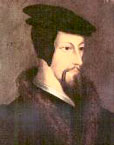
John Calvin was of the school of finance. Calvin taught that usury, the loaning of money at interest was perfectly all right as long as the rate of interest was not too high and is controlled by government action. That is nowhere in the Bible but the concept is in the Talmud! Deuteronomy 23:19 says this, "Thou shalt not lend upon usury to thy brother; usury of money, usury of victuals, usury of any thing that is lent upon usury."
|
|
John Calvin knew that. He was, after all, a theologian. But he was first a lawyer. Additionally, there are two sources that we know of which say that John Calvin came from Talmudic stock. The B'nai-B'rith stated in their newspaper The Messenger in Paris, France in 1937 that Calvin's name was first Cowen, then changed to Cauen in France, and then to Calvin in England. The second witness is the historian William Thomas Walsh, in his work on this period entitled, Phillip II, traces Calvin's ancestry back to Jewish parentage.
Calvin's religious program was centered in the cities. The leaders of his movement addressed their teaching to the classes engaged in trade and industry, who formed the most modern and progressive elements. It is in the cities where residents who know nothing of the simple rural and agriculture life but somehow seem to think they know more about how things should be done down on the farm than those living and working there!
Martin Luther taught conservative Christianity. John Calvin taught the process of progression, moving up the ladder to affluent success. Calvin's teachings became the antithesis. The systhesis has become the blend, just like Hegel taught. It is called Talmudic-Christianity!
We are discussing the very argument which Jesus explained so many times when he used the term "children." He spoke in parables. Matthew 18:3 reads, "Verily I say unto you, Except ye be converted and become as little children ye shall not enter into the kingdom of heaven. Whosoever therefore shall humble himself as this little child, the same is greatest in the kingdom of heaven." In Matthew 13:37, "He that soweth the good seed is the Son of man; The field is the world; the good seed are the children of the kingdom; but the tares are the children of the wicked one."
Luther was sowing the seeds of the kingdom as Jesus explained it. The system of Saxon England before William the Conqueror was youthful, immature, as children. Work was honourable and profitable. Making merchandise of others with money was immoral and disreputable. The medieval society of mainland Europe was very similar.
The works of Calvin, called the "Institutes" consisted of a comprehensive set of government controls, not only on the percentage of usury allowed. It also contained regulations pertaining to markets, crafts, and price controls. All of this was in a system of religion. That religion was the Talmud, not the Bible, as written!
The history of the United States over the past nearly 300 years reveals a continuation of that conflict between Martin Luther's thesis and John Calvin's antithesis. The early settlers who came here represented both sides of that conflict. The followers of Luther's concept of society would move to the rural areas. They would create a farming community with every necessity of life contained in their communities. They would sometimes have a little church, if they could. Others would provide for their spiritual training by themselves. They were happy and they were free. They provided for their own protection from any hostility, whether it be Indians or bandits. The Laws and Judgments were in their hearts.
Then John Calvin's modern progressives would move into the area and tell these rural people that they need laws, regulations and governmental control. It was called "The Philadelphia lawyer system!"
Some of our forefathers would simply move out of the area and go further west to start all over again. If we would travel the little back roads we could find little communities with surrounding farmstead houses which have been abandoned. It is a nostalgic reminder of that conflict. The western states, in particular, are full of these old communities. That is because the climate is drier and old buildings remain intact longer and are not all covered with weeds, vines, and trees. Our forefathers would repeat this process until they were up against the "Red Sea" which we call the Pacific Ocean!
In the lifetime of this writer, the same thing was most readily observed. These little western communities were surrounded with farms, ranches, logging mills and mines. The laws of the communites were so simple. They centered around God's simple commandments. Again, in secular terms, keep your word and do everything you said you would do and do not infringe on anyone else in their person or property. You see, we were free!
People from the cities who had been properly conditioned in Calvin's more "progressive ways" would come west to get in on the "good life." They would be here, not over a month, and would state that there ought to be a law, or a regulation, or a governmental control with more police powers. They would be told to go back east if they didn't like what they saw. They didn't and the west has suffered ever since.
The question before us is can we return to the Christian life which Jesus gave us? Some say, "no." We here and Christian Crusade for Truth say definitely, "yes!" Some say that we now have too many people to make it work and that argument has merit. But then we ask this: How did that happen? It was because Talmudic interests forced a total removal of immigration quotas into this nation. We have written and have spoken on this before. We have a tape titled "The Immigration Scam" which tells the story. It has been a total conspiracy and it is a lesson worth learning.
They have forced upon us peoples from other cultures who are dedicated to the destruction of that Christian culture which Jesus gave us.
But, yes, we can return. This country is full of little valleys in the southern states, little towns in the midwest, the great plains and mountains of the west. People have left their Talmudic-Christian churches. They have turned inward to their little surroundings, just like it was in our early years. They are marrying, having children, home schooling, teaching them a work ethic with hard work. They know how to grow gardens, preserve their food by various methods, and live a simple life. With a certainty they are becoming very well educated in the details of this fight. They receive, and read, every possible publication they can find to learn more. We here at Christian Crusade for Truth should know. We visit them, speak to them, break bread with them, and provide the ministerial duties of the old "circuit rider" preachers. They are the "salt of the earth" and we love them and we salute them!
Can we get back to "old-fashioned" Christianity? Yes, and with the help of God, we will. Let it be said of each and every one of us: "I have fought a good fight, I have finished my course, I have kept the faith: Henceforth there is laid up for me a crown of righteousness, which the Lord, the righteous judge, shall give me at that day: and not to me only, but unto all them also that love his appearing." (II Tim 4:7-8)