We think of governments, in general, as not being very tolerant towards its citizens. Laws are enforced with the full power of the state behind them and there is very little tolerance given. We must point out that the use of the word tolerance as discussed above is relative only to the statutes and their attendant regulations.
There is another use of the word tolerance which the governments of the Western nations have developed over the past three hundred years. They are, indeed, overly tolerant when they use the word tolerance in this second manner. We will learn in this issue of the Intelligence Newsletter how the Western Governments have misused this word for un-Biblical purposes. It is but another example of what Isaiah meant when he wrote the following:
"Woe unto them that call evil good, and good evil; that put darkness for light, and light for darkness; that put bitter for sweet, and sweet for bitter! Woe unto them that are wise in their own eyes, and prudent in their own sight! (Isaiah 5:20-21).
Most of us have been taught throughout our lives that the principle of toleration has been a major thread holding together our secular lives. We have also been taught that it has been the Christian Church which gave it to us. That is only partially true.
Most of us believe that tolerance is always a virtue, no matter how it is used. We must understand that tolerance is not always a virtue. Now, if tolerance is not always a virtue can the word represent a true virtue?
The word virtue relates to the virtues of the Bible; Faith, Hope and Charity, or Love. The acts of bravery, courage, chastity, faithfulness, honesty, goodness, integrity and justice are just examples of true virtues. The list is almost endless.
All true virtues have one thing in common. There is never too much of a virtue. Is there ever too much love, or charity, or honesty, or integrity? We all will agree that there is never too much of those virtues. So they are true virtues.
Tolerance can not be included as a true virtue because there can be, and there is, too much tolerance in our lives. It is a fact that we have too much tolerance forced upon us in our lives. It has not been of our own choosing. This issue will show us when "too much" is too much!
Shakespeare said it this way, "Pity is the virtue of the law and none but tyrants use it cruelly." Change the word "pity" for the word "tolerance" and that becomes the example for this study.
God tells us very clearly in the First Commandment, "Thou shalt have no other gods before me. " (Exodus 20:3). By stating it that way, God is telling us that there are many people of the earth who worship other gods. The entire Bible is the story of a fight between our God and these other gods. The point of this is first seen in the third chapter of Genesis.
The moment a Christian confesses to believe in One God, he denies other gods as the First Commandment demands. But there is a paradox within Christianity with respect to that point. The paradox comes when a Christian states that all other peoples of the earth belong to that same God. This, in effect, rejects the foreign gods but accepts the foreigner. That is un-Biblical because it denies the words of Jesus when he said in Matthew 15, "I am not sent but unto the lost sheep of the house of Israel. " (Mat 15:24) It denies what Jesus commanded the apostles in Matthew 10:5-6, "These twelve Jesus sent forth, and commanded them, saying, Go not into the way of the Gentiles, and into any city of the Samaritans enter ye not; But go rather to the lost sheep of the house of Israel. "
From the time of David, until about three centuries before Christ, we find Israel surrounded by huge and powerful nations of pagans and heathens. The one and everlasting difference between Israel and these other nations was that only Israel believed in One God and only One God. The theological term for that is "Ethical Monotheism." The other nations had many gods and they worshiped them in different ways.
What also set Israel apart from their neighbors was that Israel believed that God demanded justice among his people. Remember now, justice is a virtue, a virtue which, in God's eyes is unlimited.
Monotheism is by its very nature intolerant and undemocratic. Our monotheistic God has a direct interest in our well being and by His own admission, He is a jealous God and He demands obedience to His Laws. God's system of justice is divided into two types of penalties. Capital crimes demand the death penalty and He repeatedly uses the phrase, "To get the evil from among you." All remaining crimes call for restitution.. Both classes of crimes demand swift punishment. There are no prisons in God's system.
God wants the Israel nations to be separate from those peoples who worship these other gods and the reason for this is simple. Whenever those who worship these other gods come to live among us, it is somewhat natural for some of our people to become attracted socially and then physically. Compassion sets in. Tolerance for their different gods, along with their difference in moral standards becomes the common practice. It soon becomes a secular law mandating tolerance and the ones who worship the true God of the Bible become the criminals for violating the secular law. The Apostle Peter's words, "We must obey God rather than man " becomes a moot point.
Our opinion, here at The Christian Crusade for Truth, is that the Christian Churches of the Western Nations have been the root cause of the current decline and the near destruction of our Christian civilization. As we continue with that history, we believe you will agree.
The misuse of the Biblical word sojourner is a place to start. We know that the Bible provides for the care of the sojourner who comes to our land. But just what is meant by the word sojourner? From the Interpreter's Dictionary of the Bible we find three basic meanings for the word sojourner. They are:
(1) "A sojourner is a person who occupies a position between the native born and the foreigner."
(2) "A traveler and settler for a shorter or longer period."
(3) "A person living in a mutually responsible association with a community or in a place not inherently his own."
The secular dictionaries reflect this Biblical meaning. Generally, they say that the sojourner is a person who stays in a country temporarily.
The misuse of the Biblical word sojourner relates to our current study on the misuse of the word tolerance. It is in this massive, unbridled immigration where the words sojourner and tolerance are being misused. We quickly point out that this is intentional.
The Judeo-Christian Churches of today constantly intertwine the Bible with its doctrines and with the realities of today. For example, following is a typical commentary from the United Methodist Church: "The Bible is full of stories of sojourners, strangers without homes, whom God called people to protect. The Israelites, God's chosen people, were themselves sojourners for 40 years after the Exodus from Egypt before they entered the promised land. God did not let the Israelites forget that they had been without a homeland for such a long time; the ethic of welcoming the sojourner was woven into the very fabric of the Israelite Confederacy. It was more than an ethic, it was a command of God. `Do not mistreat or oppress a stranger; you know how it feels to be a stranger, because you were sojourners in the land of Egypt." That is the Methodist Church's commentary and their rendition of Exodus 23:9.
We must keep in mind, the words immigrant or immigration do not appear in the Bible. Neither does the word tolerance. The word tolerable does, however, and its context is exactly the opposite of tolerance.
Our Monotheistic God was the moral and legal code of Israel for many centuries. It came to an end about three centuries before the advent of Christ. This was the same time frame when the Talmudic community and the Pharisees came into power. Although some students believe that the Massorettes originated about 500 A.D., there is ample evidence that they were extant in the same time frame as the presence of the Talmudists and the Pharisees. It was in this same time frame that there was a decrease in the exclusiveness of the Israelites in the Palestine area. Immigration and sojourning became much more common.
The root source of modern tolerance, as we know it today, comes from the Talmud itself. From the Talmudic book Sanhedren 8:4, we find these comments. As a teaching tool, the Rabbis first present the question and then the answer. "Why did the creator form all life from a single ancestor? That the families of mankind shall not lord over the other with the claim of being sprung from superior stock ...That all men, saints and sinners alike, may recognize their common kinship in the collective human family."
There are two points to be made regarding that statement in Sanhedren 8:4. First, there are numerous theologians who now better understand the Book of Genesis and there are theological schools that teach the knowledge of pre-Adamic man. Genuine science, in archeology and anthropology have proven that there were human beings on earth long, long before Adam!
The second point is, why then, do the Talmudists of today continually insist on their "Chosen Race" theory? They, themselves, create some difficulties with that statement in their Talmudic book Sanhedrin. You can't believe one thing and the opposite at the same time. That's a double minded person! Nevertheless, it was the Talmudists who started the concept of ignoring the intolerant concepts of the Laws of our God. This is unequivocally shown in the book The Wisdom of the Talmud by Rabbi Ben Zion Bokser.
It was also the Talmudic community who forced the inclusion of the idea of toleration on all of the people, wherever they resided. Jacob Katz, in his book Exclusiveness and Tolerance, taught the exclusiveness of the Jewish people and at the same time demands toleration for that exclusiveness on the part of all of their hosts, wherever they are.
The Christian community, from the very beginning, was bombarded with the teachings of the enemies of Christ. But they were able to remain relatively secure from this teaching of cultural plurality simply because their travel was limited. The Christian culture remained within those of Israel stock.
As early as 38 A.D., Philo, who was a believing Talmudist, came into the Christian movement and began teaching the idea of all mankind being of a single community. That ripened into the idea of the "Brotherhood of man" which, as we have shown, came out of the Talmud.
Dr. George Fisher, was the Professor of Ecclesiastical History at Yale University. He wrote in 1902 that Philo taught that our Monotheistic God of the Christian Bible was a sharp antithesis to the world. In other words, Philo taught that our God does not rule in the affairs of men!
Dr. Fisher also wrote that Philo taught the Christians, while he was at the school at Alexandria, the idea of the angels of the Talmudic Jews as well as the demons of Greek mythology.
The people of the entire region, even though they may have been of Israel stock, at first considered the early church as attracting the poor and the unschooled. Christianity, was, in their minds, a religion of the ignorant masses.
The early Christians were, indeed, unlettered and unschooled in the Greek philosophies of Plato and Aristotle. The Talmudic community, with men such as Philo, brought them the teaching techniques of Plato and Aristotle. Many Christian leaders were taught the concept of dualism and other such errors.
The Christian community was no longer a religion of the ignorant masses. It became a powerful leader throughout the region. But the "Brotherhood of man" was beginning to find its way into the Christian Church.
The famous German Biblical scholar named H. Gunkel wrote these words about this infusion of heresies. "Christianity is similar to a stream which flows together from two great sources: the one is specifically Israelitish; it springs from the Old Testament; the other, however, flows through Judaism from foreign Oriental religions." The "Oriental religions" to which Mr. Gunkel referred are the Babylonian Talmud and the Oriental Cabala.
The well known Jewish writer, Dr. Louis Israel Newman of Columbia University said it this way: "Hellenism had mingled with Hebraism in Palestine from the time of Alexander the Great; In Egypt the fusion of Greek Neo-Platonism and Judaism had produced a Philo. Jewish pilgrims from the countries of the dispersion helped introduce into Palestine the Hellenic ideas which in time were amalgamated with local Judaism, and served to furnish a philosophical substratum for the new religion of Christianity which was developing."
Justin Martyr was born a Greek in the Samaritan territory and was trained as a philosopher in Ephesus. Justin Martyr was one of the more influential early teachers. He brought into Christianity some of the philosophies of Plato and Socrates. An important point we can make in our study on the development of modern tolerance is that Justin Martyr brought the idea that pre-Christian philosophies had a measure of truth.
Clements of Alexandria taught the early Church that they should not fear some of the pagan intellectual achievements. He also argued that all truth is, after all, God's truth. In his book Stramata he wrote, "They may say that it is mere chance that the Greeks have expressed something of the true philosophy. But that chance is subject to divine providence ...or in the next place it may be said that the Greeks possessed an idea of truth implanted by nature. But we know that the creator of nature in One only."
This was all called the Alexandrian tradition, from the School at Alexandria. It was there, in Alexandria, around 40-50 A.D., where the ideas for the Roman Catholic Church originated. It is sufficient to say that this tradition had an enormous influence on the later Church. Christianity was not just another philosophy among the many philosophies of the time.
It was a short 500 years later when Augustine came into the Christian movement. He, too, was an adept student of Plato, Socrates and Aristotle but he also refused to be swayed by the neo-Platonism that the Talmudists had used to infuse the heresies into Christianity. Augustine, using Plato's philosophy, wrote this: "God's plan is universal, His purpose and His will are completely carried out. The goal that is aimed at in the creation is attained. The being who has not let even the entrails of the smallest and most insignificant animal, or the feather of a bird, or the little flower of a plant, or the leaf of a tree, without a harmony, and, as it were, a mutual peace among all its parts."
Continuing with Augustine, "That God can never be believed to have left the kingdoms of men, their dominations and servitudes, outside of the Laws of His Providence. Evil exists, but evil, even moral evil, is a negation; it is the absence, or the privation, of good. God accomplished some of His purposes through the evil desires of wicked men. When evil exists, God permits it and wills to permit it."
When Augustine came into the affairs of the Christian Church, he already found a world prone to disaster, in spite of this increased knowledge of the different philosophies. There became a total indifference to the happiness of man, people who lived as waifs in a hostile environment.
When we study the history of our people in the New Testament era, we find definite repeats in conditions which cause this total indifference to happiness within our culture. Happiness, for the sake of happiness, becomes impossible to obtain and people become hardened and oblivious to it. As we will realize by the time we finish this issue, we will able readily to see that it is because tolerance is being forced on us in a totally un-Biblical way. Jesus taught tolerance but not the tolerance being taught now. We, once again, live as waifs in a hostile environment. We have become hardened to the idea of happiness. We think we can find it by taking a vacation, or going to a good movie, or even dining out at a good restaurant. But we still have in the pits of our stomachs the fact that we can't worship our God in the way He wants us to. Because men like Philo, a believing Jew, taught that all of mankind was a single community and that we are the brotherhood of man, we live in the modern world. Why are we unhappy? It is all because of the concepts of tolerance versus intolerance. Are we to be tolerant of other philosophies among us or are we to be intolerant of anything which is against God's Laws, Statutes and Judgements?
There was tremendous unhappiness at the time of the birth of Christ because of the philosophies of the Talmudic Pharisees. Jesus came to save Israel from that situation. He returned us to the faith of our fathers and he brought us back to the Laws, Statutes and Judgements of God.
But it didn't last very long. Jesse Hurlbut, in his book The History of the Bible, tells us what happened. He wrote that after the passing of the Apostles there was a fifty year period which is now called the "Age of Shadows." There is no information about that fifty year period. After that time, the Christian Church was, in many respects, a totally different church than what Jesus Christ and the Apostles gave us. It doesn't take too great an imagination to determine why we don't know anything about those fifty years nor whom it was that caused the Church to be different. That is the reason why we are now studying about the history of why we have such intolerable tolerance!
Augustine found a Christian Church that wanted mastery in the art of living. Isn't that what we are trying to find today in this modern culture? He said that the simple knowledge of wanting mastery is by no means intended that we might love it but that it is needed that we might master and possess it. Augustine wrote his famous treatise The City of God because of that most important philosophical point. The City of God did, in fact, totally change the Christian Church.
Augustine must have understood these problems very well. His writings were authoritarian in nature and he disapproved of differences of opinion within the Church. What came out of Augustine's teachings was an empire in its own right with not only ecclesiastical authority but with secular and military power as well.
The Barbarian migrations from the East were a part of the anxieties and distress among the Christian people. Historians call it the beginning of the "Dark Ages." We now understand that the "Dark Ages," as it is called, was the time of the removal of the Jewish influence within the Church! During the period when the Church had secular, as well as ecclesiastical power, tolerance as we understand it today, was not in vogue.
Augustine taught basic principles which reflected intolerance. He taught, for example, in his treatise on the Psalms that it was the Jews and not the Romans who crucified Christ!
Augustine was not the only one who taught this. Tertullian, in his writings entitled Adversus Judaeos, made serious charges against those Jews who tried to destroy Christianity. In his writing Scorpiase, he shows that it is always the synagogues which start the slanders against Christians. Any mind that is thinking can compare that to the Southern Poverty Law Center and the Anti-Defamation League of today!
The Church became strongly established in the West. The Bishop of Rome was called in Latin Papa. That later became known as the word Pope. For several hundred years, the Church and the Monarchs worked together for the good of the people. That is not the part that is remembered. The Roman Church became excessive in its power and greed. Massive tracts of land became the property of the Church. Monarchies became only figureheads.
Historically, Monarchies used the concept of filial piety and the regard for rank. Compared to that the Democracies have always stressed the virtue of personal and individual responsibility. Both of these systems can work well as long as there is humility, or high tolerance, in both the leaders and citizens.
The Roman Church became greedy and power-hungry starting at about the time of the Crusades and it lasted until the late Middle Ages. All of Western Europe became a grand killing field. We have no way of counting the number of our people who died with diseases or were slaughtered by military might.
When the Roman Church started to gather wealth to itself from the Monarchies and the people, arguments and fights between the nobility became intolerable and the people were always the ones who suffered. The army which the Roman Church developed became more powerful than the military might of the Monarchies. The noblemen became only figureheads and the allegiance of the people became confused. The allegiance was split between the Church and the Monarchies. This added to the unrest and the hatred continued building in the minds of the people.
We cannot say that Augustine's The City of God did not work. It worked extremely well for several hundred years. It was truly a magnificent period. It was a time when the Church, the Monarchs, and the people could think and act rhetorically. They had rules for argument, persuasion and speaking with eloquence and force. There were rules for manners and social customs. There was time and the desire to think in terms of how God wants our people to think. The average citizen had much more freedom than we do now. There was considerably less taxation than we have now. Even those in serfdom paid only 20 percent of their proceeds to the Monarch. The citizens had enough to tithe. But all this lasted a short several hundred years. The life which was to follow caused changes in our society that we are living with today.
The entire 23rd Chapter of the Book of Matthew is an indictment by Jesus Christ against the Talmudic Pharisees. Just imagine those Talmudists listening to the scathing words against them by the Messiah Himself! He made it very plain for them to understand in verse 38: "Behold, your house is left unto you desolate." There are many today who just can't seem to comprehend the power and intent in those few words. Then, in verse 39, he made another statement which so many Christians do not relate to what happened in Jerusalem with the Talmudic Pharisees (Jews). "For I say unto you, ye shall not see me henceforth, till ye shall say, Blessed is he that cometh in the name of the Lord. "
That happened in 68-70 A.D. when Titus, the Roman General of the Army and the son of Vespasian the Emperor, destroyed Jerusalem. That event goes down in history as the start of Christianity and the total dispersion of the Talmudic Jews which is still in effect even to this day. You must remember that it was only the Jews who had their house left desolate and not Israel. Israel had long before been dispersed and were even then in the process of being gathered.
We need to give just a little history regarding Titus in order that we understand verse 39 of Matthew 23. Prior to that assault on Jerusalem, Titus was a typical military man of the day and possessed many traits which Gibbon in his classic The Decline and Fall of the Roman Empire describes as, "the intemperance of youth." George Botsford, Professor of history a Columbia, in his book A History of the Ancient World, Macmillan Co., 1919 wrote this about the siege of Jerusalem "Titus besieged Jerusalem, their strong fortified capital. As they refused to accept any terms offered them, no quarter was thereafter given. It was a war to death. The Jews believed that God would protect His holy temple, and that at the critical moment the Messiah would come to save His people from the oppressor and to make them rulers of the world. They fought therefore with fanatic zeal, and as famine threatened they even ate human flesh. When after a five months' siege, the Romans stormed the city and the temple, the Jews killed their wives, their children, and then one another, as the lot determined, so that the victors found nothing but flames and death. More than a million Jews were destroyed during the siege." After the siege and when Titus was made Emperor of the Roman Empire, Professor Botsford wrote this about this man who was completely changed. "His kindness towards citizens and subjects alike made him the most popular of the emperors, the delight of mankind... As chief pontiff he thought it his duty to keep his hands pure." This is most significant and it relates to verse 39. Truly, he was a blessed man!
The Jewish people have been vagabonds without a "house" (country) of their own ever since. They still don't, notwithstanding what is called that modern place erroneously named "Israel!"
Those Talmudists were furious because of that divine Judgment meted out by God. A holy war, so to speak, began to regain their position of prominence and it has never abated. This fact has been described, analyzed and presented in books ever since. Each side of the conflict has presented its version. From the Christian perspective, one of the best histories of this conflict was written by Maurice Pinay entitled The Plot Against Christianity, translated from the German and the Spanish, (St. Anthony Press, Los Angeles CA)
The world must some day recognize that the Jewish religion and the Christian religion were started within about 500 years of each other! The Jewish religion was created in Babylon by the forming of the Talmud with the help of the Oriental Cabala. They were of Israel stock who had left the Israel ideals. The main thrust was to modify the Laws, Statutes and Judgments as found in the Old Testament to make them more compatible with the "Brotherhood of man." There are a great number of books by very qualified Jewish authors that describe this.
Christianity was formed by Jesus and Luke One describes why, starting with verse 67, "And his father Zacharias was filled with the Holy Ghost, and prophesied, saying, Blessed be the Lord God of Israel; for he hath visited and redeemed his people, And hath raised up an horn of salvation for us in the house of his servant David; As he spake by the mouth of his holy prophets, which have been since the world began: That we should be saved from our enemies, and from the hand of all that hate us; to perform the mercy promised to our fathers, and to remember his holy covenant; The oath which he sware to our father Abraham,... " (Luke 1:67-73).
The Churches and the Monarchies were penetrated by using heresies with the express intent to destroy the Christian Movement from within. The old concept of "Divide and Conquer" was used. They pitted one nobleman against another. They created divisiveness within the Churches. They loaned money to some of the Churches at usury. They loaned money at usury to the nobility against the demands of the Church. This created derision between the Church, the Monarchies and the people.
Their money lenders among the Vienna Traders concocted the idea of the Crusades. The world will never know the total number of men, women and children who were killed or starved to death on that totally useless venture. We can only imagine the magnitude of the interest that was obtained by the money loaned.
It remains a mystery why the Church could never understand such a simple statement of Jesus when he said, "I come not but to the lost sheep of the house of Israel." It remains a mystery today until we finally accept that men like Philo, Jerome and the host of those teachers since, who were either Jewish or totally Judaized, refused to accept what Jesus said.
But there was a time when our churches did understand, even if it was for only a few hundred years. The church leaders finally realized they had to do something. Starting in England in 1290 and ending in Spain in 1492, the Monarchies, one by one, expelled the Talmudists from their countries.
Solely because the Churches couldn't keep to the conviction that Christians must always be separate from concepts contrary to Christian beliefs, what followed became a reality. The overriding problem of that era, as well as all of the years since, was that the Christians couldn't, and can't, get together on anything. In those days, they killed each other through wars, they burned each other at the stake, they cut each other's tongues out-all because they couldn't agree on anything!
As a result of that there was a major overthrowing of the entire system in the 16th and 17th centuries. We can now address why and how that came about.
Intellectual leaders, Churches, and laymen alike agreed that this madhouse had to stop. It was in the 17th century when it was agreed that some form of toleration was mandatory as a public, secular policy. It was at this time when the Talmudic community rushed in and taught the "Separation of Church and State." They taught the absolute power of the civil government.
After consulting with the Talmudic Rabbis, the Christian leaders first addressed toleration in their churches. They agreed that it must become a public policy. The people, themselves, had become so distraught about their lifestyle, they readily accepted the concept of the secular government determining when to have tolerance and when not to have tolerance.
Thus, we were presented with a problem wherein the churches would not be able to carry out the Judgments of God as determined in the Bible unless it was approved by the secular government! At the same time the people refused to support the Ecclesiastical trials of the Catholic Church. As a result of this, the Church's supremacy was destroyed. As the Church's power dwindled, the secular government's power increased proportionately.
Vast tracts of church land was then made available for public use. There were new social arrangements made which allowed for expansion of trade with foreign nations. All of the people began thinking in two terms. They were State Sovereignty and Toleration.
We would like to quote from a very well researched book on this subject of toleration. It is called The Long Truce by A.J. Conyers, Spence Publishing Co. Dallas TX. Professor Conyers is with the Theological Seminary at Baylor University. This is what he said about how the secular powers took control of society:
"The habitual contours of society-one might say its natural arrangement within the ebb and flow of informal authority-was a function of the family, the village, the locale, the trade association, and of religion. These sometimes smaller and always subtler arrangements of customary authority in society were always potentially in competition with the comprehensive political arrangements of the modern state. They were seen as natural obstacles in the project of erecting large-scale central administration, remote from local arrangements."
"Toleration then became the means of diminishing lesser loyalties, by calling their moral authority into question; and, by thus compromising competing authorities, toleration cleared the ground for the broader, more formal power. It became the mother philosophy of the unarticulated society, the society without traditional contours of social arrangements, the mass society, the society consisting of individuals alone, individuals whose loyalty is focused on the new, remote, comprehensive authority of the state."
"It is in Europe and North America that sanctions against intolerance have been most pronounced, to such an extent that small, compact, and traditionally homogenous societies such as Japan in the East and Ghana in Africa find such fastidious attitudes puzzling and the overcautious speech of westerners amusing. And it is in great Western Universities like Stanford that 'multiculturalism' has become a serious undertaking, leaving much of the rest of the world to wonder if our fear of difference has not driven us mad." End of quotes from The Long Truce.
Our entire society has truly gone mad on the doctrine of multiculturalism and difference. Such a situation could not have happened without a controlled and detailed plan. It can be said that modern society, at least in the Western Nations, has become a society which has been conceived in abstract categories or conditions. The societies of the West now operate within the two polarized entities, the individual versus the state. This is the result of Talmudic thinking.
In this modern definition of the state, we find three separate areas of concern. They are (1) Military and War; (2) Economics; and (3) The doctrine of Toleration. It is the military and the act of war which we must discuss first in our understanding of this new system of tolerance. All of us know very well that a war of any magnitude totally disrupts society. A society has social habits which developed over many years. It takes only a few days of war and society as we knew it totally disappears overnight. Crops growing in the fields have to be abandoned. Whole populations have to move into lands of strangers. There is no way of communicating with family and other close friends under these circumstances.
The conquering military starts barking orders to the civilian population. Those orders are always strange and unsettling. From the late sixteenth century until the end of the seventeenth century, Europe had one war after another. There were all kinds of reasons for these wars. Historians even today debate on the major reasons for those European wars. But they nearly all agree that in some way or another, they were religious wars.
But with the Protestant Reformation came the dismantling of the Catholic Church. The wars that followed can be attributed to religious differences. The Thirty Years War of 1618-1648 was simply one religious war after another. Then, again from 1559 to 1689, Europe went through an anarchic period of civil wars and rebellions.
Christianity had destroyed itself. A Catholic churchman, Cardinal De Richelieu developed this new policy of the preeminence of the nation-state. He served as first minister of France from 1624 to 1642. It was this man who served the ill-famed King Louis IVth! Through the centuries, the military had made a bureaucracy out of the military administration which was successful because they developed the well-ordered and disciplined military with distinct chains of command.
A military army as conceived by Richelieu for the French was made up of people from all different ethnic groups. They differed in religious backgrounds. They were of different classes and from different locations. It was pure discipline which made it work. A soldier lost his ethnic ties and the social teaching of his youth. He could think only in terms of discipline, doing what he was ordered to do. The better he did it, the higher rank he obtained. Also, there was the honor factor which, along with total discipline, caused one soldier to give his life to save his buddies. The one principle which showed above all else in order for this system to work was that of discipline. The military army considered only his serial number and his rank. Each soldier was required to tolerate all other soldiers. The French Foreign Legion is the classic example.
Probably because of the isolation of the United States, the American Armed Forces remained segregated until after World War II!
Secular society has mimicked the military in its actions. Our own society, as we have studied it in school, has changed from its soil, its bloodlines, and its churches into a secular identity. In some aspects, society has become much more efficient as we pursue material goals. But what has changed the most are our morals and our spiritual character. Is having all of these things and communicating with all of the people of the world worth losing our morals and our Christian Spirit?
Our courts must work within the confines of a higher court. That court must, in turn, work within the mandates of an even higher court. It is nothing but the military discipline which was developed in France under Louis IVth! The United States acquired that part of the French system following our Revolutionary War.
How does our economy relate to this new system of tolerance? We have preferred contracts for the disadvantaged and the minorities. That tolerance within our economy must now include the entire world. Our modern economics almost totally removes any personal relationships within corporations and all companies in general. The stock exchanges are such that very little family or personal relationships are seen. The first jointstock company started in the 17th century. So the beginning of the Renaissance was the beginning of the removal of personal relationships in economics. The British East-India Co. separated the ownership from the management of our huge corporations.
When personal relationships became removed, it became abstract by nature. The most abstract way that exists is that of money as we know it today. The individual with his heart, mind and soul is removed from the picture. Money became king. The first bank-note was printed in Stockholm in 1660, again, the start of the Renaissance. As trade became less localized, money became more important. That brought us back to legalizing the Babylonish system of credit! It all ties together, doesn't it?
Another factor to be considered is the loss of the agrarian society where everything was directly connected with the land, air and water. With this new system of economy you don't have to own the cattle, wheat or corn. The system of farming changed. All one had to do was buy futures on the Mercantile Exchange and you were in agriculture. Someone had to work the land but its control went to the new economy. The modern farmer and rancher is nothing but a tenant on the land.
When we broke off from England and became an independent nation, that new system had to catch up with us. There was a short period when we could enjoy the old, simple economic system. There was no such thing as tolerance and pluralism in our thought processes then. Families worked together to plant and harvest.
When a new nation appears somewhere on some continent, the demands for tolerance begins. As a nation grows stronger, the demands for tolerance grows in proportion to its power. It is the glue that holds their command over the populous. Without making it some moral thing, it would all fall down around their ears.
Yes, it was the Church that authorized tolerance in religion within a secular government. It was done through the writings of certain theologians who were willing to come to grips with the wars within the churches. But it was secular government which usurped the concept and used it to create a "religion" of their own.
The first theologian for discussion is Thomas Hobbes. He lived and wrote in the early seventeenth century. In his works Leviathan he made these determinations. In his "political ethics," he contended for absolutism in government, embracing the right of the king to control, by his sole authority, all expressions of religious belief and forms of worship. He wrote that the State of Nature is the State of War, where every one desires everything and has a right to everything. The only rescue from destruction, the only way to peace, is in the institution of a common power. Hobbes thought that there was no such thing as justice before his idea of an organized society was developed and perfected. Society was a product of expediency, he taught, and might has the precedence over right.
|
|
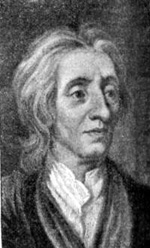
Another proponent of toleration was John Locke. He was an Englishman, born in 1632 and attended Westminster and Christchurch College at Oxford. Locke became the medical advisor for Lord Ashley who became the First Earl of Shaftsbury. Locke was the tutor to the Third Earl of Shaftsbury. This entire political entity became the beginnings of the return of the Jews to Palestine. This, itself, shows the mindset of the theory of toleration.
John Locke's writings included A Letter Concerning Toleration in 1689, Two Treatises of Government in 1690, and An Essay Concerning Human Understanding in 1693. John Locke made it most clear that, in his opinion, there was no such thing in the Gospels as a Christian Commonwealth. These documents greatly influenced Thomas Jefferson and James Madison. They read, studied, and reflected on John Locke's teachings.
John Locke influenced the development of government in the United States perhaps more than any other one person. One can readily see Locke's influence in our system of law. For example, he taught that, "Without law, imposed by the state, there is no liberty worthy of human life; wherever law ends, tyranny: begins. For this reason toleration could not possibly extend to atheists."
It is for that reason that our founders of this once Christian nation taught that our government can only be of value for a moral, God loving people. That point, made by John Locke, is certainly true. It is also on # point that we should have contention with all of this unlimited tolerance to all peoples on the face of the earth whether they are Christian or atheist. We have a society and government that is destined to fail when tolerance extends to homosexuals, abortion rights, same-sex marriages, and preferential treatment for all peoples over our own true Christian citizens whose ancestors fought, sweated, bled and died to forge this nation out of a wilderness.
When God, in His own way, removes those from among us who believe that they themselves are their own messiah and teach the brotherhood of man, we can return to the teaching of Jesus.