"And Samuel told all the words of the Lord unto the people that asked of him a king. And he said, This will be the manner of the king that shall reign over you: He will take your sons, and appoint them for himself, for his chariots, and to be his horsemen; and some shall run before his chariots,
"And he will appoint him captains over thousands, and captains over fifties; and will set them to ear his ground, and to reap his harvest, and to make his instruments of war, and instruments of his chariots, And he will take your daughters to be confectionaries, and to be cooks, and to be bakers.
"And he will take your fields, and your vineyards, and your oliveyards, even the best of them, and give them to his servants. And he will take the tenth of your seed, and of your vineyards, and give to his officers, and to his servants. And he will take your menservants, and your goodliest young men, and your asses, and put them to his work. He will take the tenth of your sheep: and ye shall be his servants. And ye shall cry out in that day because of your king which ye shall have chosen you: and the Lord will not hear you in that day." (I Samuel 8: 10-18).
In the last several issues of the Intelligence Newsletter, we have shown that throughout our history we have had the desire for a "king" to rule over us. We seem to want to be in bondage.
History shows us that we have always wanted to eulogize the "king" and to believe that God has placed him over us and we are to give him "divine rights." Apparently we derive that thought process from the stories of the Bible where the Prophets of God indicate that who our leaders should be is based on Godly principles.
However, that system is correct only when the nation is based on Biblical concepts. Alas, we don't seem to want that either! We want to make the laws. We want to be in the driver's seat. Consequently, even when we develop some form of a republican system of government (which is the basis of God's government), we then start giving our leaders "divine rights!"
Our Constitution was basically constructed around Biblical Principles. We realize that some students of our system of government believe that our founding fathers were Diests rather than Christians. However, we believe that the May-June, 1997 issue of the Intelligence Newsletter proved otherwise. Most of us should also be aware of the fact that there are several places in the Constitution which are weakly constructed. The purpose of this issue will be to show the results of those weak areas. It is not our purpose to pontificate on the points themselves but rather to show the personalities involved and their purposes for doing what they did. There is a Biblical Principle involved here, too.
"Depart ye, depart ye, go ye out from thence, touch no unclean thing; go ye out of the midst of her; be ye clean, that bear the vessels of the Lord." (Isa 52:11). Also, "Wherefore come out from among them, and be ye separate, saith the Lord, and touch not the unclean thing; and I will receive you," (II Cor 6:17).
Whenever there is someone who has been allowed to participate in our affairs who is driven by forces other than those of Christian principles, we must be prepared to endure the consequences. There was one individual involved in not only the construction of the Constitution but how it was to be interpreted and applied. That individual negated not only the intent of the Constitution itself but the deep-seated desires of the American people.
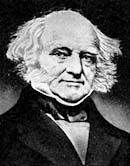
Much of the information which will be used in this history lesson will be derived from President Martin Van Buren's book entitled Inquiry into the Origin and Course of Political Parties in the United States, Hurd and Houghton, New York, 1867. Of course that book is out of print and is extremely hard to find. We were able finally to obtain a copy on loan through the Inter-Library Loan Service from Albion College in Michigan.. Please read his words slowly!
|
|
President Van Buren shows that the American Revolution left an indelible mark on the psyche, or mind, of the American people. That mindset stays with us even to this day. Even some of those who have migrated and know nothing of our American history, are caught up in this phenomenon. This is mainly because they, too, came from areas of Europe where the excesses of monarchial rule and the "divine right of kings" was the rule of government.
Mr. Van Buren shows that the origin of our political party system derives, with some modification, from the old Whigs and Tories of England. He states, "The names of these parties, like those of their predecessors in older countries, have from time to time been changed, from suggestions of policy or from accidental causes. Men of similar and substantially unchanged views and principles have, at different periods of English history, been distinguished as Cavaliers or Roundheads, as Jacobites or Puritans and Presbyterians, as Whigs or Tories. Here, with corresponding consistency in principle, the same men have at different periods been known as Federalists, Federal Republicans, and Whigs, or as Anti-Federalists, Republicans, and Democrats...But when men are brought under one government who differ radically in opinion as to its proper form, as to the uses for which governments should be established, as to the spirit in which governments should be established, as to the spirit in which they should be administered, as to the best way in which the happiness of those who are subject to them can be promoted, no less than in regard to the capacity of the people for self-government, we may well look for party divisions and political organizations of a deeper foundation and a more enduring existence."
Then President Van Buren goes on to show what it was in the hearts of our forefathers, and persists to this day among those of us whose families were among them. As we read his words, think about the degradations that have more recently occurred in our system of government, including Clinton!
"Ours arose at the close of the Revolution, and the leading parties to them were the Whigs, through whose instrumentality, under favor of Providence, our Independence had been established. They and the Tories constituted our entire population, and the latter had at first, for obvious reasons, but little to do in the formation of parties, save to throw themselves in a body into the ranks of one of them. It became at once evident that great differences of opinion existed among the Whigs in respect to the character of the government that should be substituted for that which had been overthrown, and also in respect to the spirit and principles which should control the administration of that which might be established. These spread through the country with great rapidity, and were respectively maintained with a zeal and determination which proved that they were not produced by the feeling or impulses of the moment. To ascertain the origin of those differences, and to trace their effects, we can adopt no safer course than to look to the antecedents of the actors in the stirring political scenes that followed the close of the war, to the characters and opinions of their ancestors, from whom they naturally imbibed their first ideas of government either directly or traditionally, and to the incidents of the memorable struggle from which the country had just emerged. The great principle first formally avowed by Rousseau, 'that the right to exercise sovereignty belongs inalienably to the people,' sprung up spontaneously in the hearts of the colonists, and silently influenced all their acts from the beginning."
The views of the colonists were firmly established as the result of the English Revolution of 1688. Remember, this followed the debacle of Oliver Cromwell. It was that revolution in England that formed the convictions of our forefathers.
Mr. Van Buren states, "Their advance on the road to freedom materially accelerated, by the English Revolution of 1688. The final overthrow of James II, from whose tyrannical acts as well in the character of Duke of York as in that of King, they had severely suffered, was not the greatest advantage the colonists derived from that Revolution...That Revolution, which shattered, past all surgery, the blasphemous and absurd dogma of the divine right of kings; which replaced the slavish doctrine of passive obedience and non-resistance with the principle that the authority of the monarch was no other that a trust founded on an assumed agreement between him and his subjects that the power conferred upon him should be used for their advantage, for the faithful execution of which he was individually responsible, and for a breach of which resistance to his authority, as a last resort, was a consitutional remedy."
This idea of overwhelmingly rejecting the concept of heredity of monarchs and the attendant "divine right of kings" was put to a test shortly after our independence as a nation was established. The officers of the Revolution wanted to create an organization for the purpose of honoring the military leaders. They formed an organization known as the "Society of the Cincinnati" in May, 1783. One of the provisions of the Society was to make membership hereditary for future generations! General Washington was contacted and was asked if he would allow his name to be placed at the head of the list of members. Washington apparently did not realize the implications and permitted this to happen. This immediately so agitated the public mind that public forums were organized and newspapers wrote endless editorials condemning the entire concept. Washington was forced to rescind his approval of the hereditary aspects of the "Society of the Cincinnatti!"
President Van Buren states, "The intense hostility of the colonists and their successors to monarchial institutions, and the recollection of the cruelties inflicted upon them and upon their predecessors under the authority of kings, had produced a determined repugnance on their part to the concentration of power in the hands of single magistrates. Their minds had become thoroughly impressed with a conviction that the disposition to abuse power by those who were intrusted with it was not only inherent and invariable, but incurable, and that it was therefore unwise to grant more than was actually indispensable to the management of public affairs....They could not be brought to believe that a State, to which was allowed a greater power than was reserved to its confederates (federal government vs. state government), could be restrained from the ultimate exercise of her superior power to depress her smaller confederates and to elevate herself."
There were opponents to this Biblical concept of a republican form of government where the people determined their own destiny and secured their liberty and property rights without some elevated individual or group telling them what they wanted or needed. Those opponents were not numerous but they were men who were well educated, outstanding public speakers, possessed great charisma and were dedicated to a cause (conspiracy?).
|
|
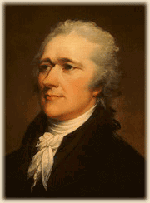
It was Alexander Hamilton who was the one man who unquestionably was the leader in changing our form of government to a powerful central government and maybe even eventually to a monarchy based on the British system. The leader among the republicans was Thomas Jefferson. Both of these men were truly giants in their mental capacity. However, their personalities were different. Alexander Hamilton was theoretical with no practicality. Thomas Jefferson was practical in his thoughts. Jefferson was a man of the soil, while Hamilton was a "city dude." Throughout the history of the United States, we have seen that same difference. Those who are of the land, making their living close to nature, are almost exclusively desirous of government at the lowest denominator. Those who are in banking, manufacturing,export, etc are often followers of Hamilton's concepts.
The names of the two concepts of government have changed several times throughout our history and many believe it to be intentional for the purpose of confusion. Even before the Constitution was written and ratified, the two opposing concepts were prevalent in America. President Van Buren describes the two systems: "The names by which these parties were distinguished are, it must be admitted, not so intelligible. The name of Anti-Federalists was strangely enough given by their opponents to those who advocated the continuance of the Union upon the principles which prevailed in its establishment, and according to which it was regarded as a Federal League or Alliance of Free-States, upon equal terms, founded upon a compact (Articles of Confederation) by which its conditions were regulated, to be represented by a general Congress, authorized to consider and decide all questions appertaining to the interests of the alliance and committed to its charge, without power either to act upon the people directly or to apply force to the States, or otherwise to compel a compliance with its decrees, and without any guarantee for their execution other than the good faith of the parties to the compact. On the other hand the name Federalists was assumed, and, what is still more extraordinary, retained by those who desired to reduce the State governments, by the conjunction of which the Federal Union had been formed, to the condition of corporations to be intrusted with the performance of those offices only for the discharge of which a new general government might think them the appropriate functionaries; to convert the States, not perhaps in name, but practically and substantially, into one consolidated body politic, and to establish over it a government which should, at the least, be rendered independent and effective by the possession of ample powers to devise, adopt, and execute such measures as it might deem best adapted to common defense and general welfare."
Following the Constitution the battle between two diametrically opposing views continued. As before, the two major combatants were Hamilton and Jefferson. Van Buren describes these men: "The President might as well have attempted to combine the elements of fire and water as to secure a harmonious action in the administration of the Government between Jefferson and Hamilton. The antagonistic opinions of these great men upon the subjects of government and its proper administration were too profoundly planted in their breasts, and they were both too honest to depart from them without a corresponding change in their convictions, which there was no reason to anticipate, to admit of a hope for a different result.
"The differences in opinion between these master spirits of the cabinet, who engrossed a share of the attention of the people inferior only to that paid to the President, were, therefore, not limited, as Washington hoped they would be, to particular measures, but presented contradictory and irreconcilable theories for the administration of the Government, which could not even be discussed in the cabinet without producing interminable distractions. As was to be expected from minds like theirs their respective systems left no middle ground, and required the adoption of the one or the other as a rule of action for the Government. The unavoidable obligation to make a selection between them devolved therefore on Washington and he discharged it, as he did all his duties, courteously and firmly. He gave the preference to Hamilton, and sustained him in the measures he proposed to carry out the policy he recommended.
"Mr. Jefferson, sensible that the necessity of his retirement from the cabinet had thus become absolute, determined to take that step in a way as little annoying to the President and as little injurious to the public service as possible. To this end he gave early notice that he would resign at the expiration of the President's first term of office; and when that time arrived he retired. This left General Hamilton without any check from his associates in the administration, save what might proceed from the Attorney General, Edmund Randolph, who became Secretary of State on Jefferson's retirement, and of whom the latter said that his habit was to give his opinions to his friends and his votes to his opponents. (In modern terms, he could have been called a "wimp." Our modern Congress is full of them!-ed.)
"Thus, next to Washington, Alexander Hamilton became the most powerful man in the nation, abundantly able to give to party divisions their form and pressure, and in effect to shape the action of the Government according to his judgment by the authority with which he was invested, and which he exerted with less restraint than had ever before or has ever since been encountered by any minister in this country or in Europe."
One can readily see why President Van Buren's book The Origins and Course of Political Parties in the United States has been lost within the library system or in the book lists! There has been a book burning in this country. It has been of the very delicate, unoffensive type. Simply remove these undesirable books from circulation very quietly and the public will never know the true history of this immense fight over which type of government we will have in the United States.
Governor Morris was his colleague in the Convention and in politics through life, and Governor Morris gave the eulogy at the grave of Hamilton when he was killed. He knew Hamilton intimately and was in perfect agreement with his views. In a letter which Governor Morris wrote to Robert Walsh, then editor of the National Gazette, he stated this: "General Hamilton, had little share in forming the Constitution. He disliked it, believing all republican government to be radically defective. He admired, nevertheless, the British Constitution, which I consider an aristocracy in fact though a monarchy in name. General Hamilton hated republican government because he confounded it with democratical government, and he detested the latter because he believed it must end in despotism, and be, in the mean time, destructive to public morality....But although General Hamilton knew these things from the study of history, and perceived them by the intuition of genius, he never failed on every occasion to advocate the excellence of, and avow his attachment to monarchiacal government.
"Hamilton not only cherished his preference for monarchical institutions to the very close of his life, but we have good reason to believe that the expectation that some crisis in the affairs of the country, encouraged by the weakness of our political system, would yet arise and would lead to their introduction, was equally abiding."
To clarify this point even more, Mr. Charles Francis Adams published a book about his grandfather, John Adams, the President. In that book he described Mr. Hamilton's desire to create a crisis which would bring about a major change in our concept of government. Mr. Charles Adams wrote, as reported by President Van Buren, "Whether it is not possible that in the pains he took to increase greatly the provisional forces authorized to meet our difficulties with France, and to convert the whole into a permanent military establishment; in the readiness with which he fell in with the scheme of Miranda, to conquer, through the joint operations of Great Britain and the United States, the Floridas, Louisiana, and the South American possessions of Spain, in case of a rupture between us and France; and in his prompt consent to take command of the troops to be so employed, General Hamilton was influenced by a desire to bring about the crisis to which he had always looked as one that would present a fit opportunity for the establishment here of the political institutions he pressured."
Considering for a moment the current concepts of crisis management with which to bring down our Constitutional government, we can look to the time of Hamilton and Washington for its source. As Mr. C.F. Adams so prophetically stated, "(Hamilton) seldoms fails to associate with dreams of their own glory the modes of exercising power for the good of their fellowmen. Considering their happiness as mainly dependent upon a sense of security from domestic convulsions, his first aim would have been to gain that end at any rate, even if it should be done at some expense of their liberties."
Further, Mr. C.F. Adams shows that, "...the policy of both administrations (Wahington and Adams) was guided by the opinions of Hamilton, but those opinions received their influence through different channels, and were enforced in very different ways. Hamilton's opinions, when known as his, had very little weight with the successor of Washington, save, in many cases, to secure a bad reception for themselves; but that successor (Adams) had little if any control over, or influence with, the members of his own cabinet, and not much with Congress or the Federal party, by whom the policy of his administration was shaped. With them Hamilton's opinions established the rule of action."
This was the start of misusing the Constitution in any way that met the needs of the moment. It was fiat government. But this still doesn't give us the mechanism with which it was done. That, too, was covered by President Van Buren's book
Mr. C.F. Adams also shows in his writings that Mr. Hamilton had the same "power of the mind," (which is his term) over Washington that he had over John Adams. President Van Buren did not agree with that assessment entirely. However, as was pointed out earlier, he did say that Hamilton's views were nearly always taken over those of Jefferson. Whatever was the whole story, we may never know for sure. But records do show that many of General Washington's letters to Hamilton are marked "private," and some "private and confidential." We do know that Washington favored Hamilton's Bank of the United States plan which is based on the Bank of England's system. That in itself is important. Money is power and we know that "power corrupts and absolute power corrupts absolutely." God, through Paul, tells us that "The love of money is the root of all evil." (I Tim 6:10).
It was Hamilton who influenced Congress into the passage of the now infamous "Alien and Sedition Act." It is the lust for power that causes political parties, such as the Federalist Party, to come up with such concepts as the Sedition law. When a party is threatened with the danger of losing their power, particularily when they have enjoyed being the leader for some time, they do things that any prudent leader would not even consider. Look at what happened to Nixon and the infamous "Watergate" debacle. Look at what is happening to Clinton and his cabinet because of the questioned legality of contributions to his party by foreign governmental interests.
The mechanism with which a massive change in the spirit of the Constitution as framed by the attendees at the convention was accomplished is perhaps best described by a statement that Govenor Robert Morris made in New York. It was shortly after the convention was over when friends in New York congratulated him that there was an agreement for the Constitution which realized the desires of the general population. Govenor Morris very quickly retorted, "That will depend upon the construction that is given to it!" Morris and Hamilton were colleagues in the desire to negate the will of the people in the use of the Constitution.
It was the doctrine of implied powers which was the root cause. Without intending to be "Constitutional whiz kids," we will simply try to show what President Van Buren observed. Remember, Mr. Van Buren was no ordinary historian. He was a Senator from the State of New York and was later to become President following Andrew Jackson, whom he worked with very closely.
Quickly reviewing the portion of the Constitution where this "implied powers" comes from we read from Article One, Section 8. After describing the numerous responsibilities of Congress, it ends with this sentence: "To make all Laws which shall be necessary and proper for carrying into Execution the foregoing Powers, and all other Powers vested by this Constitution in the Government of the United States, or in any Department or Office thereof."
That is not the way that Hamilton considered it. His intrepretation , which he openly stated, was this, "To pass all laws which they shall judge necessary to the common defense and general welfare of the Union." Reading the two passages carefully one will readily see a tremendous difference. One can also readily see that the understanding of the Congresses of today are closely related to the interpretation of Hamilton and his crowd.
President Van Buren had this to say about this difference of interpretation, "By (Hamilton's interpretation) much would of necessity be left to the discretion of those who were to execute the power, the Convention specified the powers it intended to grant under seventeen heads, and described them in the simplest and plainest language, so that none should be at a loss to understand their import. So well was this design executed that no room for doubt or cavil (to find frivolous objections, to find fault without reason.-ed.) remained to those who had no other desire than to arrive at the meaning of the framers of the Constitution."
Hamilton got his way, starting with Washington and then with enough members of Congress to overrule the Constitution. Another passage from Mr. Van Buren's book reports this:
"The nearness of the time when the Constitution was framed to the period of which we are speaking gave to this construction its most repulsive aspect. The members of the Federal Convention were yet on the stage of action, and many of them participators in the measures that were brought forward on the strength of it. The remonstrances of those who dissented on the ground of their own knowledge that the Convention did not contemplate such a construction were disregarded, not because they did not represent the truth but because the objection was inadmissible upon principle. This was emphatically the case in respect to the establishment of a national bank, the 'wooden horse' from whose side the most violent assaults have been made upon the Constitution. It was a fact well remembered by the members, and subsequently confirmed by the publication of the journal of the Convention, that a motion was made to give to Congress power to grant acts of incorporation, as facilities to public improvements. This fact was brought to the notice of President Washington by Mr. Jefferson, in his opinion upon the bank question: 'It is known,' said he, 'that the very power now proposed as a means was rejected as an end by the Convention which formed the Constitution; a proposition was made to them to authorize Congress to open canals, and an amendatory one to empower them to incorporate, but the whole was rejected, and one of the reasons of rejection urged in the debate was that then they would have power to erect a bank, which would render the great cities, where there were prejudices or jealousies upon this subject, adverse to the reception of the Constitution.'
"This communication was made directly to General Washington, who had been President of the Convention, and made to defeat a measure of Hamilton's, who never failed to turn every proposition of his opponents against themselves when it was in his power to do so. It remained unnoticed, and its truth was therefore virtually admitted. Upon the very first question, then, which arose under the Constitution upon Hamilton's construction, and that one first also in importance, the well-known intentions of the Convention were directly and intentionally overruled. President Washington gave no reasons for his decision in favor of the Bank Bill."
The Bank Bill presented by Hamilton included these points: "1. A funding system upon the English plan, with authority to assume the separate debts of the States; 2. A national bank; and, 3. An unrestricted exercise by Congress of the power to raise money, and the employment of the national revenue in patronizing individual, class, and corporate interests, according to the plan described in his report, nominally on manufactures, but embracing an infinite variety of other concerns."
Hamilton's insatiable appetite for a totalitarian, monarchial government continued throughout the years by the followers of his concepts. It is amazing, as we reflect on what must have gone through the minds of our forefathers when they saw what this man was doing to everything they held dear as to how our government was to be conducted. Why did they refrain from correcting this untenable situation?
We know that this earth and everything in it belongs to God. He knows the end from the beginning and He can bring judgment anytime He chooses. Much has been written about the conflict between Aaron Burr and Alexander Hamilton. However, could it be that God brought Divine Justice on Hamilton through the pistol duel which ended in death for Hamilton because of what he did?
The "power over the mind" of others must have been extraordinary. We know that he had charisma and intelligence. His power of persuasion must have been tremendous. We have always thought of Patrick Henry as the "fire brand" of the Revolution. He refused to participate in the Convention because he "smelt a rat!" Yet, he was convinced by Hamilton to leave the republican concepts and become a follower of Hamilton! This shows the "power over the mind" of others. President Van Buren had this to say about that, "Patrick Henry has been almost, if not quite, the only prominent man who abandoned the principles by which he had been governed during the Confederation, and embraced those of Hamilton at the coming in of the new government. Always admiring his character and conduct during the Revolutionary era, and strongly impressed by the vehemence and consistency with which he had, during the government of the Confederation, opposed every measure that savored of English origin, I pressed Mr. Jefferson, as far as was allowable, for the reasons of Henry's sudden and great change. His explanation was, 'that Henry had been smitten by Hamilton's financial policy.'"
To reiterate a point made earlier, the Jeffersonian Republicans was forced into exsistence by Hamilton's concepts of government and money. The Republicans came almost entirely from the landed interests, the farmers, cattle people, the food production system, etc. Hamilton's party, the Federalists, came from the cities, the merchants, the banks, the stock markets, etc. The two parties were created because of the continuation of the old Whigs and Tories of England. Those systems continue to this very day. The names may be changed but the intentions remain the same.
What is so surprising is that persons whom we would have thought to be diametrically opposed to Hamilton's system succumbed to the sweet smell of money! "The love of money is the root of all evil." We have been taught and we have read in so many books that "President Washington was the father of our country." This statement now, after learning about the Hamilton-Jefferson conflict, must have a different meaning. He was the "father" of what type of country? What type of government was the result?
In Washington's Farewell Address, we read this statement: (The continual mischief of political parties) "serves to distract the public councils, and enfeeble the public administration. It agitates the community with ill founded jealousies and false alarms; kindles the animostity of one part against another; foments occasional riot and insurrection. It opens the door to foreign influence and corruption, which finds a facilitated access to the government itself through the channels of party passions. Thus the policy and the will of one country are subjected to the policy and will of another."
One must wonder whether he was talking about the Jeffersonians and their conflict with Hamilton or vice-versa. In any case, that conflict did exactly as Washington predicted. The two current major political parties have indeed accomplished everything he predicted. We have ill founded jealousies and false alarms. We have animosity of one party and its constitutients against the other. We have had riots and insurrections throughout our history because of it. Perhaps the most famous was the Shay's Rebellion. There should not be a person in the country who is not knowledgable about the current devastating debacle over campaign donations received from foreign entities. This scandal has indeed brought direct influence into our government and sadly into our very quality of life in this country.
The United Nations and the NAFTA, GATT, WTO treaties have influenced our way of life to the extent that we can honestly say that we live in a different country than that of our forefathers. This, too, has been because of the continued conflict between the moneyed class and those who produce our basic wealth from the ground (including the farming, ranching, mining, timber, and fishing, etc.).
To further complicate the problem, it is now difficult, if not impossible, to differentiate between the two major parties. It is sad to read that Patrick Henry was one of the first to combine the two systems. The contest between the two parties can now be stated as, "Me, too, only better!"
We now have one big party system, Hamiltonian Federalism in nature, and rapidly becoming totalitarian. The two parties have melted together into one with the express purpose of feeding an oligarchial system with an imperial president. We have become an Imperial Republic. We have become what Hamilton wanted, a monarchy (the President) and his court (the monied, corporate structure). The rest of America has become the servant to that system, the serfs of the old monarchies. There is book after book, written by authoratative researchers, that reflects this trend in American history and politcs.
According to the majority of these researchers, our presidents have thrived on foreign involvement, crisis, and war. They show that presidential power increases each time the United States has expanded into foreign countries and each military, commercial or diplomatic crisis.
Using the power of the "Commander in Chief," the American presidents have expanded their power by deploying military troops overseas. President James K. Polk created the war with Mexico in 1848 by sending American troops into the disputed lands between Texas and Mexico. The Mexican army fired on the American soldiers and Polk immediately wrestled a declaration of war from Congress.
Lincoln then used this situation for his own benefit when he wrote, "Allow the President to invade a neighboring nation, whenever he shall deem it necessary to repel an invasion...and you allow him to make war at pleasure." He then asked Congress to try to set limits on the President's power.
Then Lincoln turned around and did the same thing. He refused to call Congress into special session when the situation deteriated. He unilaterally blockaded naval ports in the South. He expanded the military forces beyond Congressionally prescribed numbers. He spent money for purposes not approved by Congress. He declared martial law and arrested citizens without judicial procedures. He suppressed newspapers and suspended Constitutional rights. Edward S. Corwin in his book The President: Office and Powers, New York 1957 states, Lincoln's actions "assert for the President for the first time in our history, an initiative of indefinite scope in meeting the domestic aspects of a war emergency."
President Lyndon Johnson deployed naval destroyers close to the North Vietnam coast in the Gulf of Tonkin. This openly provoked the North Vietnamese. He then requested a resolution from Congress authorizing the president "to take all necessary measures" to become involved. It later turned out that Congress had already prepared that resolution. Thus, we have a one party imperial court at the pleasure of the president.
Woodrow Wilson, in his book Constitutional Government in the United States (New York 1908) made a very prophetic statement: "The President can never again be the mere domestic figure he has been throughout so large a part of our history. The nation has risen to the first rank in power and resources....Our President must always, henceforth, be one of the great powers of the world, whether he acts greatly and wisely or not....We can never hide our President again as a mere domestic officer....He must stand always at the front our affairs, and the office will be as big and as influential as the man who occupies it." As one can see, the President of the United States has become so powerful that the concept of "divine rights" has become almost meaningless.
Perhaps the one thing that has permitted this, besides the one party imperial congress system, has been the development of the secrecy of governmental actions in the name of national security. This has become a ruse, or stratagem, to keep the ordinary citizen ignorant of governmental actions. Men have written about how this has been accomplished. It has supposedly been the technology of modern times which has in a sense modified our Constitutional system. In their analysis, the President has become the only man who is capable of understanding the problems which are caused by secrecy, time and the complexity of the situtation. All of this does nothing but shield the president from the scrutiny of the voting citizen. Thus, so many Americans have come to the realization, "Why vote?"
There has been at least one other major situation which has also caused the two parties of our forefathers to become a one party imperial system. Quietly, as we were busy making a living for our families, the judicial system decided to make as many of the laws among the various states as uniform as possible.
It is obvious that some of the laws of the nation could be uniform without each state losing its rights as an individual state. But there is a limit to which this effort should have gone.
From a book entitled A Centennial History of the National Conference of Commissioners on Uniform State Laws by Walter P. Armstrong, West Publishing Co., we can find a wealth of knowledge on such an endeavor. The preface sets the stage for their efforts. Quoting only from this preface at this time because of space limitations, we read this:
"On the occasion of its Centennial Celebration that commences with it 100th meeting in 1991, the National Conference of Commissioners on Uniform State Laws is pleased to present this chronicle of its creation and first century's work. The Conference is an organization peculiar to the federal system of government we enjoy and is unique in American Law. 'American Law' actually consists of fifty separate and potentially differing bodies of state law, co-existing with, and overlaid by federal law. The fact that most Americans are unaware of this complex legal matrix is due in some measure to the success of the National Conference in achieving 'Uniform State Laws.'
"...For the nation's first 100 years, this system of legal diversity worked fairly well, although in one sense the Civil War grew out of the decidedly non-uniform state law concerning slavery. But after that war, as the nation came together again, moved westward, expanded its borders, began to industrialize, and acquired the means of transcontinental travel, the need for a common, predictable, nation-wide legal system became crucial. There were at least two methods for unifying the legal systems of the states. State law could be preempted by the Federal Government through repeal of the Tenth Amendment, or by expansive interpretation of the commerce clause and other express powers delegated to Congress. Alternatively, the states could create a forum and a vehicle by which they could voluntarily agree to develop, and then separately adopt, uniform legislation on important subjects of common concern. That was the path chosen in 1891 when the Conference was conceived. It is probably not coincidence that the origin of the Conference occurred during the Centennial celebration for the Bill of Rights and the Tenth Amendment."
The entire book then goes on to show how the members of the conference gathered together created uniform laws suitable to a Federalist concept. Obviously, whenever a law was then contested by an individual from a state, it was adjudicated by Supreme Court Justices who were taught the Federalist concept. Such an individual, of course, was Justice John Marshall whom we have discussed in earlier issues. It is obvious as to the results. We have an oligarchy just as Hamilton wanted.
"And the children of Israel did evil in the sight of the Lord, and served Baalim: And they forsook the Lord God of their fathers, which brought them out of the land of Egypt, and followed other gods, of the gods of the people that were round about them, and bowed themselves unto them, and provoked the Lord to anger. And they forsook the Lord and served Baal and Ashtaroth." (Judges 2:11-13).
"And the children of Israel did evil in the sight of the Lord: and the Lord delivered them into the hand of Midian seven years. And the hand of Midian prevailed against Israel: and because of the Midianites the children of Israel made them the dens which are in the mountains, and caves, and strong hold. And so it was, when Israel had sown, that the Midianites came up, and the Amalekites, and the children of the east, even they came up against them;" (Judges 6:1-3)